

How Do They Add Sound To Movies
Movies and Film: A Brief History of Sound in Movies
A Cursory History of Sound in Movies
We all know that first there was silent picture and then there was sound. Simply that's not the whole story. Before films talked they still fabricated themselves heard through intertitles and musical accompaniment. And later the introduction of the microphone, there were yet questions nearly how to utilize the technology. Here is a cursory breakdown of the evolution of sound.
Y'all Ain't Heard Nothing All the same: Earlier Sound
Brusk Cuts
Though intertitles tended toward the brief and explanatory, the author or managing director could choose to be lush or poetic. Sometimes the poetry was positively purple, as in the following intertitles from Erich von Stroheim's The Wedding March (1928):
Then, nature mourned—
The Birds were hushed—
It rained, rained, and rained ….
And
Oh Dear—Without the—Marriage is a sacrilege and a mockery.
Though Edison did not invent moving picture, he always conceived that this visual medium and his phonograph would mesh to make sound moving picture, and was busy trying to invent sound picture almost from the birth of picture palace—from about 1885—more than a third of a century earlier sound film became commercially feasible.
Inventors and entrepreneurs needed to overcome several problems before sound could be accepted. First, silent picture show audiences seemed perfectly happy with silent movies, perhaps because the movies were never completely silent, nearly e'er accompanied by music of some kind: from a multipieced pit orchestra for large openings, to a single pianoforte, or even a guitar if no i in a small town could play the larger instrument.
Early on, when film prints traveled from pocket-sized boondocks to small boondocks in the American heartland, they were often narrated by a live raconteur, who would explain the action on-screen to audiences. "Intertitles"—those cards between moments of action—contained explanations of activeness, or of import moments of dialogue, or even bits of poetry to set the mood.
Too, by the 1920s, silent film writing, acting, photography, and music had reached an aesthetic pinnacle: very subtle emotional and plot nuances could be conveyed without the utilize of any accompanying dialogue. In fact, as the era of audio flick drew to a close, filmmakers were able to convey their stories with a bare minimum of intertitles.
Inventing Sound
Second Accept
The Jazz Singer (1927) was not the first commercially released sound film. Warner Brothers and Vitaphone had earlier been releasing "shorts" in which people sang and told jokes, and released a feature-length film called Don Juan, which contained a musical score, in 1926, the year before Al Jolson sang "Mammy" on picture. In fact, Jolson'due south talking was in large mensurate an accident: The film-makers simply couldn't close the irrepressible entertainer up be-fore his musical numbers.
More important than audience satisfaction with silence, withal, was the technological difficulty of matching sound and visuals in such a mode that everyone in the audience could hear. In other words, the problems were synchronization and distension.
Unlike the invention of moving picture, the solutions to these bug were largely American, the upshot of the work of several American corporations: RCA, Western Electric, AT&T, and Warner Brothers. Two of those corporations formed a third, Vitaphone, which produced the outset commercially viable sound arrangement, substantially a very big phonograph platter hooked upwards to a film projector with large leather belts, like straps or harnesses. Soon this clumsy appliance was replaced by the at present-standard strip of celluloid prepped for sound that runs down the side of the movie strip, and then that the 2 modes remain in synch.
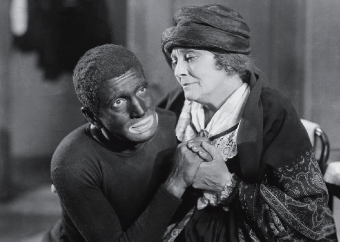
Al Jolson belts out "Mammy," and Warner Brothers becomes a major film studio.
Even after its invention, sound presented a host of problems. The early sound cameras and equipment were large and noisy, and had to exist kept in their own soundproof room, called a "blimp." And it took a while for someone to effigy out that you could motility the microphone effectually by placing it at the cease of a stick—called a "boom"—just in a higher place the range of the photographic camera. Then very early sound films tended to be very static because actors had to speak to a static mike, and cameras move no longer had that graceful and supple fluidity it had been developing for 30 years. (Some of the issues with early sound film are hilariously portrayed in the MGM musical Singin' in the Rain [1952]).
Other nontechnological bug had to be resolved at the advent of sound: Some actors did not audio the fashion they looked on the silent screen.
Information technology was hard for silent scene writers to observe the right residual in sound scripts between action and dialogue. Studios justifiably feared losing the international audition that silent motion picture could automatically rely on. So on. Nonetheless, later on these and other early problems with audio were solved, this engineering became another element that filmmakers could play with to make filmgoing even more pleasurable than it had been.
Second Take
The clich exclamation that silent film stars with funny voices could not take to the new microphones and and then sank into oblivion is, for the nigh part, untrue. In fact, lots of very famous sound actors had perfectly successful silent careers: Joan Crawford, William Powell, Myrna Loy, Ronald Colman, and Gary Cooper, to name just a few. When silent actors did not succeed, it was not so much because of their voices every bit because they did not adapt well to the new kinds of roles demanded by sound film.
Manager'south Cutting
Information technology is rumored that the person to solve the problem of speaking into a static microphone was a adult female—manager Dorothy Arzner—who is supposed to take invented the "boom microphone" to get those actors moving, and to get the motility back into move pictures.
Director'south Cut
In the early on sound era, the aforementioned picture show would exist shot in two or three languages, so that they could however entreatment to an international audition earlier subtitling and dubbing had been widely used. For example, after the shooting of the English language version of Dracula (1931) and everyone went home, the night crew came in to shoot the Spanish version, with a different director and Spanish actors, which many horror motion-picture show aficionados believe to exist the superior version. Unfortunately, this solution proved cumbersome, and was not used very frequently. Equally a upshot, movies are no longer as international as they were, at least in the sense that American audiences are at present less likely to watch foreign films considering dubbing and subtitles just seem to almost people like inefficient substitutes for plain speaking.
Look Who'south Talking: Audio Changes the Industry
The addition of sound did not simply hateful that actors could at present talk; it meant large changes in the way that films were produced. Scenarists at present had also to be dialogue writers. Literary types from the other arts were imported to Hollywood to assist write the new talkies: Dorothy Parker, Robert Benchley, William Faulkner, and Ernest Hemingway, for instance.
Actors at present had to be paragons of articulateness and fluency also as pantomime artists. Certain exotic roles became far less fashionable, in part considering foreign accents were harder to understand with primitive microphone and amplification technologies, in role because the fantasy of the Asian vamp or the Italian villain seemed more kitschy with the added reality of sound, and in part because some foreign types began to seem rather stereotypical and xenophobic. With the exception of Chico Marx, dumb immigrant Italians started disappearing from the screen, along with Jewish shyster lawyers. Native American stereotypes—monosyllabic grunts and all—persisted much longer, but finally began being scrutinized in the 1950s, and even satirized in such films every bit Blazing Saddles (1974) by the 1970s.
Some verbal kinds of one-act—most conspicuously typified past the Marx Brothers—was only not possible until sound. A host of comedians came from vaudeville and the stage to assist round off the new cast of talking characters: Jack Benny, Bob Promise, George Burns and Gracie Allen, and and so on. At to the lowest degree one new comedy genre sprang up at this time: screwball one-act, a combination of romantic comedy and some very featherbrained behavior, that relied on sophisticated banter of the leading couple. The traces of screwball remain in our culture to the present day in films like Pretty Woman (1990) or When Harry Met Sally (1989), and in many prime number-fourth dimension sitcoms.
And, of course, at least one whole genre would not have been possible without audio: the musical. With a volatile history, going in and out of popularity very oft, this genre persists in some class to the present twenty-four hours, from the "backstage musical" of the late 1920s, to the Fred Astaire-Ginger Rogers films of the Bully Low, to the big color MGM productions of the 1950s, to the MTV video, to the rockumentary, to the musical interludes of The Simpsons.
Excerpted from The Consummate Idiot's Guide to Movies and Film © 2001 by Mark Winokur and Bruce Holsinger. All rights reserved including the correct of reproduction in whole or in office in any course. Used past system with Alpha Books, a fellow member of Penguin Group (United states) Inc.
To order the east-book book directly from the publisher, visit the Penguin USA website. You can also buy this volume at Amazon.com.
- Movies and Film: Fade In: A Brief History of Editing

How Do They Add Sound To Movies,
Source: https://www.infoplease.com/culture-entertainment/film/movies-and-film-brief-history-sound-movies
Posted by: davisshmed1990.blogspot.com
0 Response to "How Do They Add Sound To Movies"
Post a Comment